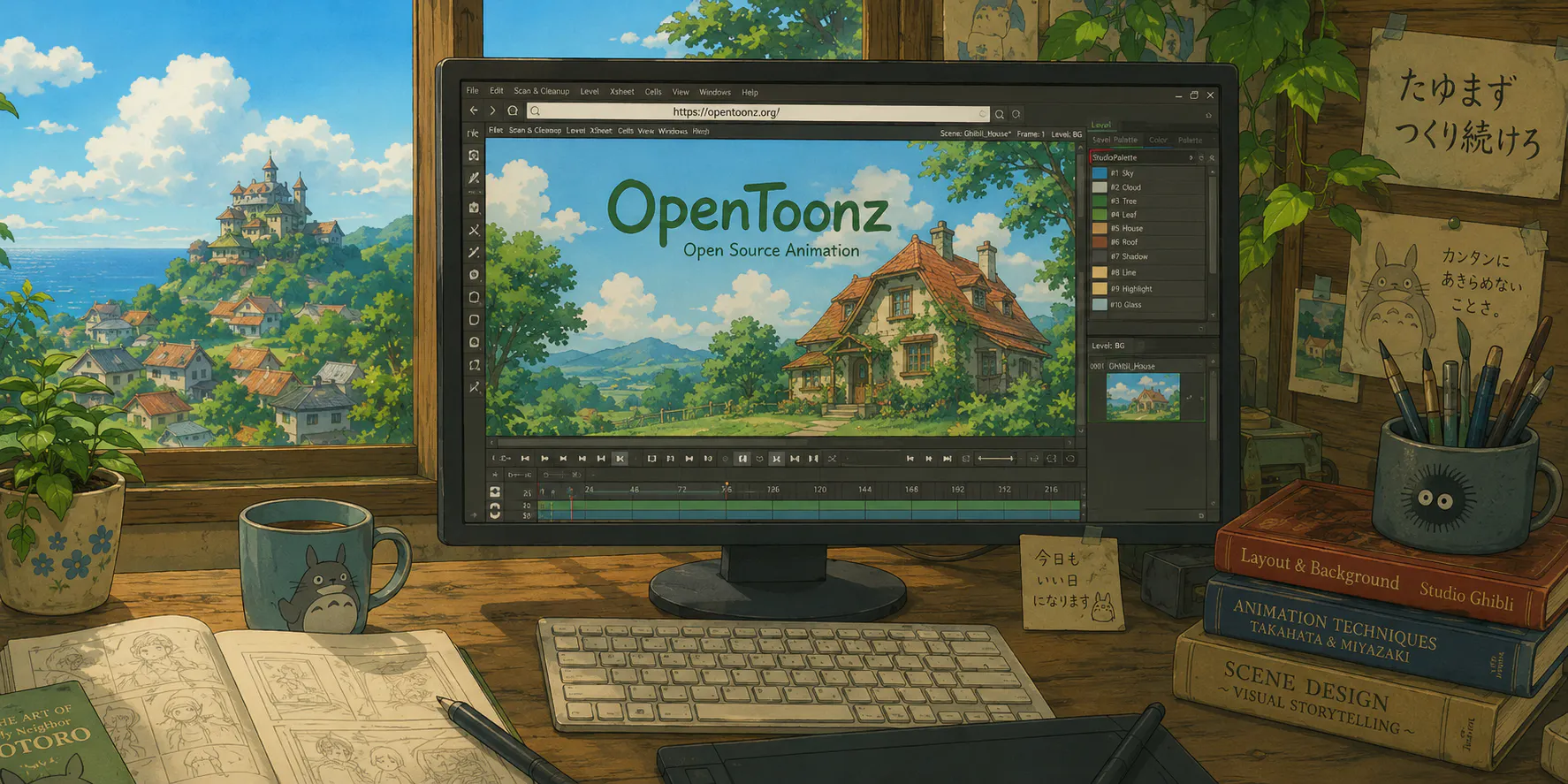
opentoonz/opentoonz is a BSD-3-licensed 2D animation tool with 5,400+ stars, 616 forks, and 5,025 commits on GitHub. It powered the 2024 Best Animated Feature Oscar winner. You can clone it right now, build it on your machine, and ship a feature film with it.
It costs nothing. Adobe Animate — now in maintenance mode — runs $34.49/month.
This is not a theoretical comparison. One of these tools rendered The Boy and the Heron. Here's what the repo actually contains, why it matters, and how to start using it.
A 33-Year-Old Codebase That Refuses to Die
The software in opentoonz/opentoonz started in 1993. Not as open source. Not as a startup. As an Italian animation tool called Toonz, built by Digital Video S.p.A. in Rome, running on SGI IRIX workstations and distributed by Softimage.
Microsoft bought Softimage. Toonz came along. Then in 1995, a small Japanese animation studio asked to license it. That studio was Studio Ghibli.
They didn't just license it. They lived inside it. Starting with a few cuts on Princess Mononoke in 1997, Ghibli's technical team — led by developer Shun Iwasawa, who still commits to the repo today — bent the software to match how Miyazaki actually works. They built GTS, a scanner purpose-built for animation cels. They built IwaWarper, a texture-warping tool for painting effects onto hand-drawn contours. They built palette systems that let you repaint an entire character across 2,000 frames by changing one swatch.
Then in 2016, Dwango bought the rights and open-sourced the whole thing under BSD-3. The condition was explicit: it had to go public.
That's how one of the most battle-tested animation codebases on earth ended up free on GitHub.
Every Ghibli Film You Care About Ran on This
This isn't a hobby tool Ghibli tried once.
The OpenToonz use-case page makes it plain. Arrietty. The Wind Rises. The Tale of the Princess Kaguya. When Marnie Was There. And The Boy and the Heron — the one that won the Oscar.
On Heron, every drawing was scanned through GTS. Color design happened in OpenToonz. All scenes were composed and rendered in OpenToonz. New FX nodes — GlareFx, FloorBumpFx, the FlowFx series — were developed for the film and shipped back into the v1.7 release. HDR rendering for Dolby Cinema was added for this production.
And it's not just Ghibli. Studio Ponoc animated Mary and The Witch's Flower entirely in the open-source version. Studio Chizu moved pencil testing for Belle to OpenToonz because it was more stable than their previous software. Trigger uses it on Promare, Kiznaiver, and BNA. Rough Draft Studios — the Futurama people — used the original Toonz.
The Market This Sits Inside
Let's zoom out. The numbers around 2D animation are staggering and still accelerating.
The global 2D animation software market was valued at roughly $2.8 billion in 2024 and is projected to hit $8.5 billion by 2034 — a 10.1% CAGR. The broader animation software market (2D + 3D + motion graphics) was estimated at $141.6 billion in 2023. North America holds about 38% of that.
But the demand side is even more telling. Japan's anime industry hit a record $25.3 billion in 2024 — up 14.8% year-over-year — with overseas revenues surging 26% to $14.27 billion. A decade ago that number was $10.6 billion. The Association of Japanese Animations confirms that international markets now outweigh Japan's domestic earnings for the second straight year.
The global anime market overall was valued at $37.7 billion in 2025 and is projected to reach $77.3 billion by 2033 at a 9.2% CAGR. Japan's government wants to triple overseas content sales to $131.4 billion by 2033 under its revised Cool Japan initiative.
Here's the thing: somewhere between 35-46% of content creators still prefer 2D tools over 3D for marketing, educational, and streaming work. E-learning — another huge demand driver — is heading toward $375 billion. Over 70% of Japanese professional studios now use digital tools, up from near-zero 15 years ago.
All of this demand is being served by essentially three tools: Toon Boom Harmony (excellent but expensive), Adobe Animate (in maintenance mode), and OpenToonz (free, open, used by the best studio on earth). The structural gap between market demand and accessible tooling is enormous.
What's Actually in the Repo
Open opentoonz/opentoonz and you'll find roughly 90% C++, 6% C, built on Qt 5 and CMake. The architecture maps directly to a classical cel animation pipeline:
- toonzlib — scene and xsheet data model
- tnztools — drawing tools (brush, eraser, fill, vector editing)
- stdfx — the visual effects library
- tiio — format I/O for PNG, TGA, TIFF, PSD, AVI, plus native formats (PLI, TLV, TZP) that have no equivalent anywhere else
The core abstractions — ToonzScene → TXsheet → TXshCell → levels in vector, raster, or "Toonz raster" — are the digital version of the paper exposure sheet that studios have used since the 1930s. Sounds like legacy baggage. It's the feature. The data model matches how studios actually work.
The repo also includes 301 open issues, 17 open PRs, active GitHub Actions CI running builds for Windows, macOS, and community Linux, and a wiki with build instructions. The last stable release (v1.7.1) shipped May 2023. The v1.8 nightly preview has been building continuously since late 2025.
How to Get Started (For Real)
Clone and build it:
git clone https://github.com/opentoonz/opentoonz.git
cd opentoonz/toonz
mkdir build && cd build
cmake ../sources
make -j$(nproc)
You'll need Qt 5, CMake 3.16+, and the usual C++ build chain. Full build instructions are on the repo wiki. On Windows, the installer downloads are easier. On Linux, community builds ship via GitHub Actions artifacts — both GCC and Clang flavors.
First animation in 5 minutes: Open OpenToonz → File → New Scene → grab the Brush tool (B) → draw on frame 1 → hit the + key or navigate to frame 2 in the Xsheet → draw frame 2. Hit play. You just did frame-by-frame animation in the same tool Ghibli uses. The official documentation covers everything from there.
Write your first plugin: Clone the Plugin SDK. Write an image-processing effect in C. Compile to a .plugin shared library. Drop it in the plugins/ directory. It appears as a node in the FX Schematic — no OpenToonz rebuild needed. The DWANGO sample plugins (BSD-3, links OpenCV3) are your reference implementation.
Automate with ToonzScript: OpenToonz ships an ECMAScript-based scripting language built on QtScript. Classes like Level, OutlineVectorizer, Transform, and Image let you batch-process frame sequences from the Script Console. The Morevna Edition fork adds command-line execution — exactly what you want for CI pipelines.
The deep learning angle: The neural_style_plugin runs a Caffe model (NIN ImageNet or VGG-16) inside the FX graph. A neural net running as a compositor node in a 2D animation tool. These models are 2016 vintage — the real 2026 opportunity is integrating modern diffusion models through the same Plugin SDK. Nobody's shipped that publicly yet. That's your opening.
The Miyazaki Philosophy That Produced All This
You can't understand why this repo exists without understanding what Ghibli believes about animation.
In 2016, Dwango's AI Lab showed Miyazaki an AI-generated zombie animation during an NHK documentary. After a long silence, Miyazaki responded: he found it deeply disturbing, said it was an affront to the dignity of living things, and refused to ever incorporate such technology. Guillermo del Toro later echoed the sentiment.
He's not anti-technology. Ghibli has used digital tools since 1997. But Miyazaki insists that animation is an act of empathic observation. You watch how a child reaches for something. How wind moves through grass. You draw what you observed. Tools that bypass observation produce dead images.
That's why Ghibli customized Toonz instead of buying anything off the shelf. They needed a tool that scanned paper drawings without destroying line variation. That handled ink-and-paint in ways that preserved the hand. That could warp painted textures onto contours without flattening the drawing underneath.
opentoonz/opentoonz is what you get when the most demanding traditional animator alive helps spec a piece of software for 30 years.
Where Adobe Animate Fits (Barely)
Quick version: Adobe announced in February 2026 that Animate would be discontinued. After significant community pushback, Adobe reversed to "maintenance mode" — no new features, security patches only. Adobe's FAQ recommends migrating to Adobe Express and After Effects. Adobe's focus is shifting toward Firefly and Express — AI-generated content and quick-turnaround video creation.
The Price Comparison
Toon Boom Harmony Premium: $139/month, or $3,215 per 3-year subscription. Perpetual licenses are gone. For a 10-seat indie studio: $16,680/year.
Adobe Animate: $22.99–$34.49/month. Now in maintenance mode.
OpenToonz: $0. BSD-3. Used to render Oscar-winning features.
The Blender Parallel
Same arc. In-house tool at a Dutch studio (NeoGeo, 1994) → open-sourced via crowdfund (€100,000 in seven weeks) → 20+ years of UX grumbling → Flow wins Best Animated Feature at the 2025 Oscars.
OpenToonz is roughly where Blender was in 2010. Technically dominant in narrow niches. Ugly for everyone else. Waiting for a UI rewrite.
The gap: Blender Foundation reported €3.1 million in 2024 income, with corporate sponsors like Meta, NVIDIA, Microsoft, Adobe, and Epic. OpenToonz has Dwango plus volunteers. No foundation. No dev fund.
Blender 2.8 — the left-click UX overhaul — made Blender mainstream. OpenToonz hasn't had its 2.8 moment. The Tahoma2D fork exists because the community got tired of waiting.
The Caveats
The UI is rough. Famously rough. The learning curve is steep. Linux support is community-maintained. Crashes during heavy vectorization are common enough that auto-save every 3 minutes is standard.
"Studio Ghibli used it" oversells the on-ramp. Ghibli used a heavily customized version refined over 15+ years. You won't produce Ghibli quality by downloading OpenToonz any more than you'll produce Pixar quality by downloading Blender.
Toon Boom Harmony is genuinely better for rigged TV animation — Rick and Morty, Bojack Horseman. Harmony's rigging tools remain the standard for cut-out work.
But for hand-drawn feature animation? For scanning and compositing and ink-and-paint? For a BSD-3 tool inside a $25.3 billion anime industry growing at 15% annually?
There is no second option.
What Comes Next
The market signals are clear. A $77 billion anime market by 2033. An $8.5 billion 2D software market by 2034. Over 70% of Japanese studios now using digital tools. Japan's government trying to triple overseas anime sales to $131 billion by 2033.
The XDTS exposure sheet format that Celsys and the Japanese animation industry are converging on? OpenToonz ships a viewer for it. Interop is already happening.
The pipeline of the future is polyglot. Clip Studio for drawing. OpenToonz for compositing. ToonzScript and the Plugin SDK for automation. The opentoonz/opentoonz repo needs contributors for Linux packaging, a UI overhaul, modern build tooling, and Python bindings. There are 207 contributors and 5,025 commits. Room for more.
All of it open. All of it forkable. None of it dependent on a licensing decision you don't control.
Because I Want to Be Prompted in the Future, I'll Leave You With 101 Studio Ghibli-Style Movie Ideas
opentoonz/opentoonz is free. Blender is free. Krita is free. The technical barriers to making something beautiful have never been lower. The only barrier left is the idea. Take one. Make it.
- The Last Lighthouse Keeper — An aging woman maintains the only lighthouse on an island between the living world and the dead.
- A Fox Called Wednesday — A bakery apprentice discovers the stray fox she's been feeding is actually an exiled rain god.
- The Cloud Cartographer — A boy maps clouds from his rooftop in Osaka, until one cloud maps him back.
- Grandmother's War — A grandmother recounts her childhood evacuation through a countryside that remembers the bombs differently than she does.
- The Color Thief — A girl born colorblind discovers she can steal colors from dreams, but each theft leaves the dreamer a little duller.
- Rust and Rye — Two retired farming robots debate the meaning of harvest in a field that no longer needs them.
- The Understudy — A shadow separates from its owner and auditions for the school play.
- Salt Tide — A fishing village trades its memories to the sea in exchange for calm waters, until a girl refuses to forget.
- Komorebi Station — A train station only appears when sunlight filters through leaves at the right angle, connecting towns that no longer exist.
- The Paper Lantern Parade — Paper lanterns carry the wishes of the dead through the sky; one lantern carries a wish no one made.
- A Thousand Cranes, One Lie — A hospital patient folds origami cranes for a wish that was already granted — she just doesn't know it yet.
- The Moss Collector — An old botanist discovers that the moss on a shrine wall is the compressed memory of everyone who ever prayed there.
- Wind Farmer — In a world where wind is currency, a family on the poorest hilltop discovers they're sitting on a gale.
- The Borrowed Cat — A cat lends itself to lonely people for exactly three days. No more. No exceptions.
- Dragonfly Post — Letters between two pen pals are delivered by dragonflies that cross a war zone neither writer knows about.
- The Bathhouse at the Edge — Not Spirited Away — a bathhouse where mountains come to soak, and the towel girl is the only human allowed.
- Spindle and Spark — A weaver discovers her thread can stitch torn friendships back together, but the thread comes from her own hair.
- A Song for the Whale Road — A mute girl hums a frequency that guides lost whales home through polluted shipping lanes.
- The Stargazer's Debt — An astronomer owes a star a favor from childhood and the star has come to collect.
- Root and Branch — Two trees on opposite sides of a wall grow toward each other underground. Told across 200 years in 90 minutes.
- The Ink Drinker — A calligrapher's apprentice accidentally drinks enchanted ink and begins speaking in poetry she can't control.
- Snowmelt — A snowman who survived winter must decide whether to seek summer or accept that survival was the miracle.
- The Typhoon Catcher — A girl with a butterfly net tries to catch a storm to bring rain to her grandmother's dying garden.
- Fermentation — The bacteria in a jar of kimchi tell the story of the family who made them, across three generations.
- The Postman's Route — A rural postman delivers one final letter to an address that hasn't existed since the dam was built.
- Tide Pool — A boy discovers a tide pool that shows the ocean floor 10,000 years ago. Something down there is still alive.
- The Kite Hospital — In a village where kites carry souls, a repairwoman patches torn kites to keep the dead from being forgotten.
- Hollow Bones — A girl who can talk to birds discovers that migratory birds carry the stories of every land they've crossed.
- Cicada Summer — The cicadas this year are louder because they're trying to warn the town about something underground.
- The Mapmaker's Daughter — Her father maps imaginary countries. One day she finds proof that one of them is real.
- A Garden Between — A rooftop garden exists simultaneously in Tokyo and São Paulo. Two strangers tend it without knowing the other exists.
- The Lantern Fish — Deep-sea fish carry the last memories of sunken ships. A diver wants to return one memory to shore.
- Bridge of Crows — Every autumn, crows form a bridge between two mountains so the mountain gods can visit each other.
- The Forgetting Rain — Rain falls once a decade that makes everyone forget one thing. A librarian catalogs what's been lost.
- Clay Girl — A potter's unfinished sculpture comes to life and goes looking for the hands that almost completed her.
- The Beekeeper's Ghost — A beekeeper dies and his bees continue following his routine, leading his granddaughter to honey he hid decades ago.
- Snow Monkey Parliament — A hot spring where monkeys go is actually a parliament where they debate whether humans are worth saving.
- The Bicycle Kingdom — Abandoned bicycles in Amsterdam form a society at the bottom of the canals.
- Noodle Song — A ramen shop owner can taste the emotions of whoever grew the wheat in her noodles.
- The Umbrella Graveyard — Broken umbrellas go to a field to decompose. One refuses because it never sheltered anyone.
- Peach Fuzz — A peach tree spirit falls in love with the farmer who planted it and must decide between bearing fruit or bearing witness.
- The Radio Tower — An abandoned radio tower still broadcasts one show: a lullaby sung by a woman who died in 1952.
- Driftwood — A piece of driftwood has been every kind of boat, bridge, and home. Now it wants to be a tree again.
- The Night Librarian — Books rearrange themselves at night based on who needs to read them next. The librarian tries to keep order.
- One Thousand Steps — A shrine at the top of 1,000 steps grants wishes, but each step takes a year from your memory working backward.
- Featherweight — A sumo wrestler's daughter weighs nothing. Literally. She has to hold onto things to avoid floating away.
- The Tea House Between Worlds — A tea house serves exactly one customer per century: whoever needs it most.
- Copper and Verdigris — A copper statue watches a city change over 300 years and narrates the story of the one family that never left.
- Tanuki Taxi — A tanuki shapeshifts into a taxi driver and takes passengers where they need to go, not where they asked.
- The Paper Airplane War — Two classrooms communicate only through paper airplanes, not knowing their schools are about to merge.
- Mushroom Radio — A mycelium network under a forest floor carries the conversations of trees. A girl taps in.
- The Fisherman's Knot — A fisherman ties a knot that accidentally binds two rivers together, flooding a town with fish that don't belong.
- Skywhale — A whale-shaped cloud becomes real for one hour each decade. A pilot has been waiting 30 years for it to return.
- The Glass Blower's Breath — Each piece of glass contains the breath of the artist. When the glasses break, the breaths escape and remember.
- Old Growth — The oldest tree in a forest is actually a petrified giant who fell asleep during an argument with the mountain.
- The Sundial's Shadow — A sundial's shadow points to things instead of times: lost objects, missing people, oncoming danger.
- Ash and Ember — Two fire spirits — one destructive, one warming — are siblings who haven't spoken since they burned down a village by accident.
- The Seed Vault — A girl discovers the Svalbard seed vault has one drawer labeled "Do Not Plant." She plants it.
- Porcelain Heart — A ceramic doll in an antique shop remembers every owner. The next one is the great-grandchild of the first.
- Fog Horn — A lighthouse foghorn has been communicating with something in the deep for 80 years. It finally responds.
- The Quiltmaker — A woman quilts the entire history of her town. When the quilt is stolen, the town starts losing its history.
- River of Bells — Bells from sunken temples ring underwater during earthquakes, warning villages along the coast.
- The Clockmaker's Apology — A clockmaker who stopped every clock in town to delay his wife's death must restart them when she asks him to.
- Pollen — A girl allergic to everything discovers she can hear what flowers say about the humans who planted them.
- Stone Soup for Ghosts — A traveling cook feeds ghosts who are too proud to admit they miss being alive.
- The Hammock Between — A hammock strung between two cherry trees lets you sleep in someone else's dream.
- Kiln Fire — A dragon too small to fly discovers she's the perfect temperature to fire pottery, and finds a village that needs her.
- The Frost Line — A boundary in the forest where it's always winter on one side and always spring on the other. A deer crosses.
- The Typewriter's Memory — An old typewriter has memorized every letter written on it and begins composing its own.
- Well Water — A wishing well that actually works. Each wish is granted by a different creature below, each interpreting it their own way.
- Night Soil — A farmer discovers the compost pile behind her barn is alive, and it remembers every plant it's ever become.
- The Bridge Toll — A troll under a bridge charges stories instead of coins. She's heard them all. Until one traveler tells her something new.
- Indigo — A dyer's hands are permanently blue. She can touch fabric and see its history. She touches a wedding kimono with a terrible story.
- The Nest Builder — A man who builds birdhouses discovers that the birds are building him a house in return. In a tree. In the afterlife.
- Kettle Song — A cast-iron kettle sings while boiling. Its pitch tells you the emotional state of whoever will drink the tea.
- Paper Boat Armada — Paper boats children launched in a Tokyo gutter arrive in the Pacific and form a floating island.
- The Elevator Between Floors — An elevator stops between floors 3 and 4, where an entire unmapped floor exists.
- Lighthouse Keeper's Dog — The keeper is gone. The dog still turns on the light every night. Ships still follow it.
- The Persimmon Tree — A persimmon tree planted over a grave grows fruit that lets you taste one memory of the person buried below.
- Snow Globe — A girl shakes a snow globe and discovers the tiny people inside are shaking back.
- The Chimney Sweep's Atlas — A chimney sweep has seen the inside of every house in the city from above. He knows every family's secret.
- River Stones — Stones skipped across water arrive on the far shore of a world that mirrors this one, slightly worse.
- The Origami Zoo — A lonely zookeeper's paper animals come alive at night, but they can only exist inside the zoo.
- Threadbare — A coat passed between seven strangers over 40 years, each person adding a patch that tells their story.
- The Bonsai Architect — A bonsai master discovers each miniature tree contains a tiny civilization. Pruning has consequences.
- Milk Teeth — A child's lost teeth are collected by a mouse who builds something specific with them. It's not what you think.
- The Matchstick Girl Grows Up — She survived. Now she sells solar lamps to children who can't afford light. But the cold remembers her.
- Compass Rose — A compass that doesn't point north — it points toward the thing you need most. A sailor follows it inland.
- The Bellmaker — A bell maker crafts a bell whose ring can stop time for exactly one breath. She uses it to save her town.
- Salt Lick — Deer visit a salt lick that's the calcified tears of a forest spirit. They carry her grief away in their blood.
- The Weaver's Error — A weaver intentionally puts one flaw in every tapestry because perfection angers the gods. One day she forgets.
- Glass Bottom — A glass-bottomed boat tour guide discovers that the reef below is a sunken city, still populated.
- Charcoal — A charcoal burner discovers his charcoal retains the memories of the tree. Artists drawing with it see things they've never seen.
- The Attic Door — A door in the attic opens to whatever room the house needs most. Today it opens to a room that hasn't existed for 50 years.
- The Mending Wall — A wall between two farms mends itself every time the neighbors fight. They've been fighting for 200 years. The wall is exhausted.
- Morning Glory — A morning glory vine grows so aggressively it reaches the stratosphere. A girl climbs it to return a seed the wind stole.
- The Bento Box — A mother's bento lunches contain hidden messages. Her daughter discovers them 20 years late, after the mother is gone.
- Soot — The soot in a factory chimney becomes sentient after 100 years of absorbing the workers' conversations.
- The Ferry at Dusk — A ferry that runs at dusk carries passengers between two islands. Some are alive. Some aren't.
- Pressed Flowers — A herbarium's pressed flowers reanimate during a thunderstorm and try to return to fields that are now parking lots.
- The Animator's Last Frame — An old animator draws one final frame. The characters look back at her and wave goodbye.
Pick one. git clone https://github.com/opentoonz/opentoonz.git. Draw the first frame. The software is free. The stories are free. The only expense is your time and attention, which — if Miyazaki is right — is the only thing that ever mattered.